Amaro - Designing Omnichannel Retail Experiences

Updated: Sep 11
Company: AMARO
Role: Product Designer
Year: 2022

Context
When I joined AMARO as a Product Designer, I took on a new challenge in my career: designing experiences for physical retail.
Until then, most of my experience had been focused on digital products. Working with AMARO’s Guide Shops gave me the opportunity to understand how digital products, physical stores, internal tools, employees, and customers come together to create a single experience.
My work focused on improving the Guide Shop experience, with projects involving experiences such as Click & Collect, assisted sales, and express delivery.
1-Understanding the business and the context
One of the first things I learned was that designing for physical retail requires a deep understanding of the operation behind the customer experience.
I worked closely with Product Managers and business stakeholders, visited stores, and conducted research with both customers and store employees. These interactions helped me understand not only customer needs, but also the operational constraints and processes behind each experience.
This proximity to the business allowed me to identify opportunities that would not have been visible from a purely digital perspective.
2-Looking beyond the NPS
NPS was an important metric for AMARO's stores. Customers who completed a purchase generally reported high satisfaction.
However, when we spoke to customers who weren't purchasing, we discovered a different perspective.
A simple satisfaction survey helped us identify opportunities beyond the experience of existing customers and understand some of the barriers preventing people from completing their journey.
This reinforced an important principle in my process: looking only at customers who successfully complete a journey can hide some of the most relevant problems.
Mapping complex omnichannel experiences
Designing for retail meant working across multiple touchpoints and systems.
The customer journey could involve:
AMARO's digital products
Store employees
Mobile devices and tablets
Payment terminals
Point-of-sale systems
Internal operational tools
Delivery and fulfillment processes
Because these experiences were interconnected, I needed to map the different scenarios and understand how one interaction affected another.
I created flows for experiences such as Click & Collect, assisted sales, and express delivery, helping the team visualize the different paths and identify potential gaps in the customer journey.

Image: Omnichannel flows for Click & Collect, assisted sales, and express delivery
Using prototypes to align complex experiences
Retail flows can become complex very quickly, especially when multiple systems, users, and operational scenarios are involved.
For this reason, interactive prototypes became an important part of my process.
Instead of presenting only static screens or user flows, I used navigable prototypes to demonstrate the complete experience, including interactions and different scenarios.
This also made collaboration with Engineering more effective. We could discuss technical feasibility early, identify constraints, and make decisions together before development.

Image: Click & Collect flows and features

Image: In-store sales flows and features
Designing for the employee experience
The customer experience in a physical store is deeply connected to the employee experience.
I interviewed store employees and managers to understand the challenges they faced at different levels of the operation.
I also invited members of the Product and Technology teams to observe some of these interviews. This helped bring real user insights into the product development process and allowed different stakeholders to better understand the problems employees were facing.
These conversations helped me identify differences in needs depending on the employee's role and responsibilities.

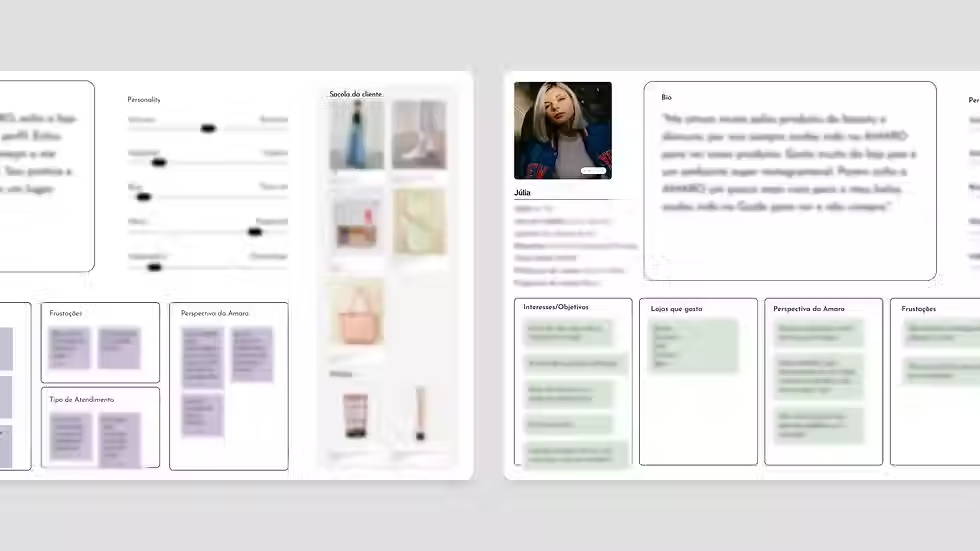
Image: Employee personas created from interviews
Challenging assumptions about the customer
Another important part of the research was understanding whether the customers we were designing for actually matched the assumptions held by stakeholders.
As AMARO expanded its physical retail presence, customer profiles could also change.
Through focus groups and interviews with customers in physical stores, I identified different profiles, including potential customers and existing brand advocates.
The research helped the team build a more evidence-based understanding of the audience and supported discussions around business and product decisions.
Mapping the customer journey
Mapping the customer journey inside a physical store was one of the biggest challenges of the project.
Unlike a linear digital flow, the physical journey could change depending on the customer's behavior, the store environment, the employee interaction, and the service being used.
Through store visits and observation, I mapped the different stages of the journey and identified pain points across the physical space.
One example was the journey for Click & Collect, where I mapped the experience from the customer's perspective and identified opportunities throughout the process.

Image: Click & Collect customer journey

Image: In-store customer journey and pain points by stage/location
Takeaways
Working at AMARO expanded my understanding of Product Design beyond digital interfaces.
I learned to think about products as connected ecosystems, where the customer experience depends on technology, physical environments, employees, business processes, and operational systems working together.
It was also an important step in developing my approach to omnichannel experience and service design, and in understanding how research and prototyping can help align complex experiences across different teams.


Comments